Choosing between a catamaran and a monohull for a family charter is less about “which is better?” and more about what will make everyone sleep well, eat well, and move around confidently when the sea is doing its thing. The difference shows up quickly: in the first ten minutes on board, at the first windy reach, and at 3am when someone is looking for the loo without wanting to wake the whole boat.
Both platforms can deliver a brilliant holiday. They simply do it in different ways.
What families notice first
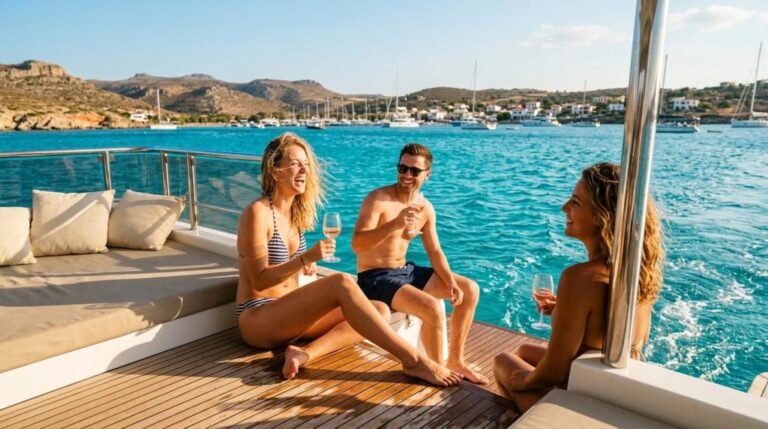
Most families stepping aboard a cruising catamaran comment on the width and the sense of calm. The boat sits level at the dock, and the main living area is usually on one level: cockpit flowing into the saloon, with big sightlines so you can keep an eye on children without hovering.
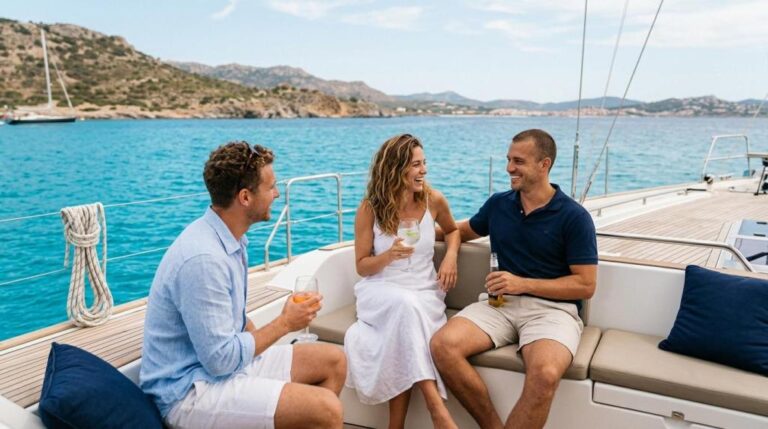
A monohull feels narrower and more “boat-like” straight away. There is often a few steps down into the saloon, the galley is more compact, and moving fore and aft tends to be single-file. Many sailors love this cosier feel because it matches what they expect a sailing yacht to be.
Comfort below deck: cabins, bathrooms, and the real-life layout
On family charters, comfort is often decided by three things: how easy it is to sleep, how easy it is to shower, and how easy it is to exist together without feeling on top of one another.
On many modern charter catamarans, the accommodation is split between two hulls, with cabins in each hull and a large central saloon and galley above. That layout makes privacy easier, even with a full boat. It also means cabins can be more similar in size, which matters if you want to avoid the “best cabin” debate.
Monohulls place everything along a single hull. You still get good cabins, but they are narrower, and there is less separation between sleeping areas. Heads are often shared between cabins, particularly on mid-size boats, so morning routines can take a little planning.
Noise is rarely a deal-breaker on either type, yet it shows up in different ways. Catamarans often have two engines, which can mean more engine sound when motoring. At anchor, the flatter stance can feel quieter for light sleepers because the boat is not rocking as much. Monohulls can creak and shift slightly when they roll, and the gentle side-to-side motion can either soothe you or keep you awake, depending on the person.
After a day ashore, the comfort differences that families tend to value look like this:
- Privacy: catamarans separate cabins across two hulls; monohulls keep everyone closer together
- Bathrooms: many cats offer one head per cabin; many monohulls require sharing
- Night-time movement: flatter decks on cats make it simpler to walk around; monohulls can be more lively at anchor
Space on deck: where the holiday actually happens
Families rarely spend a charter sitting silently below. The cockpit becomes the dining room, the foredeck becomes the daybed, and the swim platform turns into a constant launch point for snorkels and paddleboards.
Catamarans win on usable outdoor space for their length. Their beam can be dramatically wider than a monohull of the same overall length, and that width becomes extra seating, wider side decks, and a larger cockpit. Many designs add a forward netted area that children adore and adults quickly claim for reading.
Monohulls do offer lovely deck areas, but they tend to be more segmented. The cockpit is usually the main social space, with the foredeck and side decks narrower. This is not “worse”; it simply means you plan how many people can lounge in the same spot.
At anchor, deck space shapes your day in small ways. On a cat, you can set up lunch while someone naps in the shade and another person sorts masks and fins without anyone needing to shuffle around. On a monohull, the same activities are still possible, just closer together.
Stability and motion: what it feels like underway and at anchor
Stability is the headline reason many families choose a catamaran, and it is not just about comfort. It affects confidence, appetite, and how much children and older relatives enjoy moving around.
A catamaran resists heeling strongly. Under sail it stays much flatter, so people can read, cook, and walk about with fewer “grab points”. At anchor, cats often sit level with less roll, which can be a gift if anyone is prone to motion sickness.
A monohull heels as part of normal sailing. Many people find that thrilling, and it is the classic sailing sensation. It can also be tiring for non-sailors, because the boat may be angled for long periods, cupboards feel less friendly, and the saloon table becomes noticeably sloped.
There is a nuance worth knowing: some catamarans can “slap” when a short chop hits the bridge deck, producing a sharper sound and a quick upward bump. It depends on the sea state, the design, and speed. A heavier monohull can feel more like a steady pendulum in the same conditions, with slower, rounder movements, even though it is heeling and rolling more.
If seasickness is a concern in your group, it often helps to think in plain terms: would you rather have more tilt and roll (monohull), or less tilt with occasional quick bumps in certain chop (catamaran)? People vary.
Safety, confidence, and children moving around
Family charters are full of little moments: a child carrying a plate, someone stepping out of the companionway, a grandparent holding a rail while the boat swings at anchor.
A level platform reduces the number of “unplanned gymnastics” moments, which is why cats are regularly chosen for mixed-age groups. Wide decks and netting forward can also add reassurance, although good seamanship and sensible rules matter more than any single design feature.
Monohulls have their own safety strength: they are designed to self-right after a knockdown. That is a core part of the monohull concept. In everyday charter conditions with prudent routing and a good crew, either platform can be a safe home, but the feeling on board differs, and that feeling changes how relaxed people become.
Draft, anchorages, and the places you can reach
A practical advantage of many cruising catamarans is shallower draft. That opens up anchorages closer to beaches and can make it easier to tuck into water that a deeper-keeled monohull might avoid. For families, this can mean shorter dinghy rides, more swim stops, and less time planning around depth.
Monohulls, with deeper keels, can still access a huge number of anchorages and marinas. They may also be happier in some swell patterns at anchor because the hull shape and weight can feel more settled. The trade-off is that you sometimes anchor a little further out.
Where you are chartering matters. In some Mediterranean hotspots, berth availability and marina layouts can make a wide catamaran slightly more fiddly, while in many island groups the shallow draft feels like a real benefit. A broker or charter manager can help match the boat to the itinerary, which is one reason experienced charter clients often use a specialist.
The sailing feel: speed, upwind habits, and handling
If someone in the family actively wants to sail, not just be transported between swim stops, this part matters.
Many cruising catamarans do well reaching and can be fast in the right angles, with a comfortable, flat ride. They may not point as high into the wind as a good monohull, and tacking angles can be wider, which can affect routing when the breeze is forward of the beam.
Monohulls often shine upwind, and the feedback through the helm can be more engaging. The boat heels, loads up, and talks to you. Sailors who grew up on monohulls sometimes find that emotional connection is a big part of the holiday, even if the accommodation is tighter.
Handling in marinas differs too. Cats have two engines spaced far apart, which can make close-quarters manoeuvring very controlled in skilled hands. Their windage can be higher, so strong crosswinds need respect. Monohulls are narrower, which can reduce berth-width stress, yet they may rely more on prop wash and spring lines rather than “engine on each corner” control.
Costs, crew, and charter availability
Budget can push the decision either way. Catamarans often command a premium for their space, popularity, and family-friendly layouts. Monohulls can offer strong value if your group is smaller, or if you would rather spend on experiences ashore and keep the boat simpler.
Crewed versus bareboat also shifts the calculation. With crew, even a more compact monohull can feel easy because someone else is handling meals and manoeuvres. On bareboat, families often appreciate the forgiving living spaces of a cat because daily life is happening in the same areas where you also manage lines, snorkels, and snacks.
Companies with heritage in sailing and long experience across regions, including Nicholson Yachts and other established charter specialists, often guide clients by asking about the people on board first, then the itinerary, then the style of boat. That order tends to lead to happier charters.
Side-by-side comparison
| Category | Catamaran (typical cruising charter) | Monohull (typical cruising charter) |
|---|---|---|
| Living space | Wide saloon and cockpit; “open-plan” feel | Cosier interior; narrower saloon and galley |
| Cabins and privacy | Cabins split across two hulls; good separation | Cabins close together; more shared space |
| Bathrooms | Often one head per cabin on family-focused layouts | Often fewer heads; sharing more common |
| Motion under sail | Minimal heel; flatter decks | Heels noticeably; classic sailing feel |
| Motion at anchor | Often less rolling | Can roll more depending on swell |
| Seasickness risk (general) | Often lower for mixed groups | Can be higher for non-sailors |
| Draft and anchorages | Frequently shallower; closer to beaches | Frequently deeper; may anchor further out |
| Marina berthing | Wide beam; needs space and planning | Narrower; fits many berths more easily |
Picking the right hull for your family, without overthinking it
If you are travelling with very young children, older relatives, or anyone who worries about balance, the calmer platform and extra room of a catamaran is hard to ignore. It is simply easier to live on, minute to minute.
If your group is smaller, keen to sail properly, or likes the romance of a traditional yacht, a monohull can be the more satisfying choice, even if it asks you to pack lighter and accept a bit more motion.
A useful way to decide is to picture your normal day on board: breakfast, a short passage, a swim stop, lunch, a siesta, and an evening at anchor. Then ask a broker to show you two or three real boats in each category, because design details matter as much as hull type.
Once you have that picture, the decision often becomes straightforward:
- Family priorities: “space to spread out” and easy living generally point to a catamaran
- Sailing priorities: “feel, trim, upwind work” often point to a monohull
- Practical priorities: shallow anchorages favour cats; narrow berths can favour monohulls