A luxury yacht charter is relaxed by design, but it is not casual in the same way as a hotel stay or villa holiday. You are stepping into a private, highly organised environment where comfort, safety and discretion all sit side by side. That is why etiquette matters.
The good news is that the rules are fairly simple once you know them. Most of them come down to respect: respect for the crew, the yacht, fellow guests and the places you visit along the way.
Why yacht charter etiquette matters on board
A yacht runs on detail. The crew is managing navigation, service, housekeeping, food, watersports, guest schedules and safety, often all at once. Small acts of courtesy make that work smoother and help the whole charter feel easy.
Etiquette is also practical. Shoes can damage teak, smoke can trigger alarms, careless posts on social media can compromise privacy, and awkward tipping at the end of a trip can leave a poor last impression. Knowing the basics beforehand avoids all of that.
One more point matters here: each yacht has its own house rules. The captain has the final word on safety and onboard procedures, so any guidance from the crew should always take priority over general custom.
Yacht charter tipping etiquette by region and charter type
Tipping is one of the first things new charter guests ask about, and with good reason. It sits in that awkward space between hospitality, travel custom and personal judgement. On yachts, the accepted approach is much clearer than many people expect.
In most cases, crew gratuity is calculated as a percentage of the base charter fee, not the APA, VAT or other extras. A common range is 5 to 15 per cent, with 10 per cent often treated as a useful benchmark for a standard week-long charter. In some markets, especially US and Caribbean charters, guests often give 15 to 20 per cent. In parts of Europe and the Mediterranean, 10 to 15 per cent is more typical, while some Asia and South Pacific charters can sit lower.
| Region | Typical crew gratuity | Notes |
|---|---|---|
| Mediterranean | 10% to 15% | Often linked to MYBA custom |
| USA / Caribbean | 15% to 20% | Generally more generous tipping culture |
| Asia / South Pacific | 5% to 10% | Can be lower depending on itinerary and yacht |
Short charters are a little different. On a day charter, many guests tip 10 to 15 per cent of the day rate, or agree a flat amount if that feels simpler. A longer charter, where the crew is delivering round-the-clock service for several days, usually justifies a higher percentage.
The other important point is how the gratuity is given. Standard practice is to hand one amount to the captain at the end of the charter, usually in an envelope or by pre-arranged transfer if cash is inconvenient. The captain then shares it among the whole team. That matters because a yacht charter is a group effort, including crew you may see only briefly or not at all.
After discussing the overall range, it helps to keep a few tipping basics in mind:
- Base fee only: calculate gratuity on the charter price, not on APA, taxes or fuel
- Captain first: hand the gratuity to the captain for distribution
- End of charter: leave it on the final day, not at the start
- Service-led: adjust within the usual range if service was notably strong or disappointing
If you are unsure, your broker can tell you what is customary for the yacht and region. charter guides, including those published by Nicholson Yachts, place the expected range towards the more generous end, around 15 to 20 per cent, so it is always worth checking what standard applies to your booking.
Yacht shoe etiquette and the barefoot rule
This is one of the easiest rules to follow and one of the most important. In simple terms, outdoor shoes usually come off when you board.
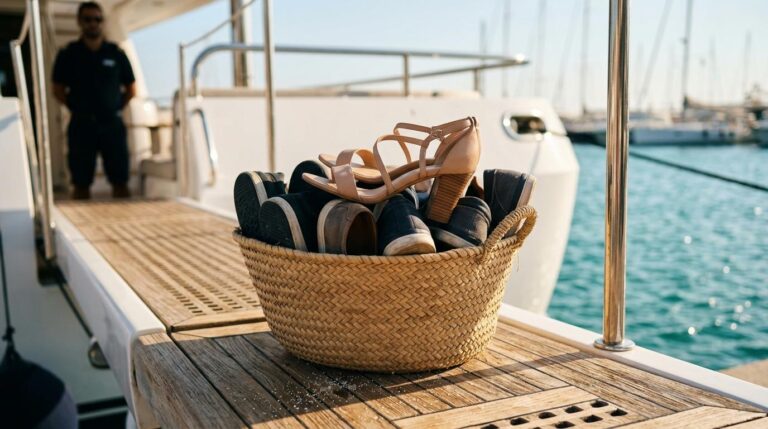
Teak decks are beautiful, expensive and surprisingly easy to mark. High heels can dent them, dark soles can scuff them, and street shoes bring on dirt, grit and salt. That is why many yachts ask guests to go barefoot or to wear approved soft-soled deck shoes only.
You will often see a basket or storage area at the gangway for footwear. That is normal, not formal. It is just part of looking after the yacht.
If footwear is needed, choose clean, non-marking and soft-soled options. White-soled deck shoes, light sandals and some boat shoes may be allowed on certain exterior decks, depending on the yacht. Inside, barefoot is still the safest assumption unless the crew says otherwise.
A sensible packing list usually includes:
- flip-flops for shore
- soft deck shoes
- sandals with non-marking soles
- smart evening wear
- no stilettos on board
There can be exceptions. If the deck is hot, wet or slippery, the crew may suggest suitable footwear for safety. If carpet protection has been laid for an event, certain shoes may be allowed in that area. The point is not that shoes are always banned everywhere. The point is that the yacht decides what works, not the guest.
Yacht smoking and vaping rules guests should expect
Most luxury yachts ban smoking indoors completely. That includes cabins, saloons and enclosed decks. Smoke detectors are sensitive, interiors are difficult to restore if odours linger, and the fire risk is taken very seriously.
Smoking is usually limited to a designated outdoor area chosen by the captain. Often that will be on an aft deck or another spot where smoke is less likely to drift back inside. Cigars may be restricted even more tightly because the smell carries further and stays longer.
Vaping is commonly treated in the same way as smoking. Guests sometimes assume e-cigarettes are exempt, but on many yachts they are not. If you would not light a cigarette in that area, do not assume you can vape there either.
Before the first evening on board, it is worth asking exactly where smoking is permitted. That avoids awkward reminders later, especially if children, non-smokers or formal dining are part of the charter setup.
A few smoking habits are never acceptable on board:
- Inside cabins: not allowed
- Near open doors: smoke drifts quickly into the interior
- Over the side: cigarette ends and ash should not go into the sea
- Without asking: always check the designated smoking spot first
That last point matters just as much in port as it does at anchor. Local marina rules and harbour regulations may be stricter than the yacht’s normal practice.
Yacht privacy etiquette for guests, crew and social media
Privacy is one of the great luxuries of a yacht charter, and it works both ways. Guests expect discretion, but crew members also need space to work and rest without intrusion.
Crew areas are not guest areas. That usually includes the galley, bridge, laundry, crew cabins, technical spaces and storage areas unless you have been invited in. The galley can feel especially tempting because it is such a lively part of the yacht, but it is still a working zone. A quick hello is fine when invited. Wandering in mid-service is not.
The same principle applies to fellow guests. Unless you are family or travelling as one close group, another guest’s cabin is private space. Even on a charter with a relaxed house-party atmosphere, bedroom etiquette stays much closer to a private home than a hotel corridor.
Privacy now includes phones as much as physical space. Yacht guests should be careful with photography, video and posting. A beautiful anchorage photo may seem harmless, but tagging the location in real time can reveal more than intended. Including crew or other guests in posts without asking can create its own problems.
The best approach is simple:
- Ask before filming: especially if crew or children are visible
- Delay posting: share locations after you have left, not while you are still there
- Keep business private: take sensitive calls away from communal spaces
- Respect off-duty time: crew are friendly, but they are still at work and need rest
Quiet courtesy goes a long way here. Voices carry on water, and yacht layouts mean conversations travel further than people think.
Guest behaviour that helps the crew deliver better service
Luxury service does not mean mind-reading. The best charters tend to be the ones where guests are clear, polite and realistic about what they want.
That starts before embarkation. Many brokers and charter companies send out a preference sheet covering food dislikes, allergies, drinks, watersports, celebrations, medical needs and travel timings. Filling it in properly matters. It helps the chef provision well, gives the captain a better sense of the group, and cuts down on last-minute changes that can be difficult in remote anchorages.
Once on board, communicate through the right people. If you want to change the day’s plan, ask the captain. If you have a food request, speak to the chief stewardess or chef through the crew structure the yacht uses. This is not about hierarchy for its own sake. It simply keeps service organised and avoids mixed messages.
A few guest habits make life easier for everyone:
- being ready on time for transfers
- saying if plans have changed
- keeping cabins reasonably tidy
- mentioning allergies early
- telling the crew if something is wrong while it can still be fixed
Politeness matters, but clarity matters too. If lunch should be later, if a child needs a simpler dinner, or if a particular wine should be chilled before sunset, say so. Most crews would much rather know than guess.
Practical yacht etiquette before you pack and board
Many etiquette issues are settled before the yacht even leaves the dock. Packing smartly, reading the embarkation notes and asking questions early can prevent most common mistakes.
Soft bags are usually better than hard suitcases because storage space on yachts is limited. Clothing tends to be relaxed in the daytime, with smarter outfits for dinner depending on the charter style. Some charter advice from Nicholson Yachts reflects exactly that balance: casual daywear, practical deck shoes or flip-flops for shore, and proper dinner clothes for the evening.
If there is anything that may affect onboard rules, mention it well in advance. That could include smokers in the group, guests with mobility concerns, very young children, security sensitivities or a wish for extra privacy around photography and staff interaction.
A smooth charter often comes down to small pieces of preparation rather than grand gestures. Know the tipping custom, leave the shoes at the gangway, smoke only where permitted, keep private spaces private, and listen to the crew. Once those basics are in place, the rest tends to feel very natural.