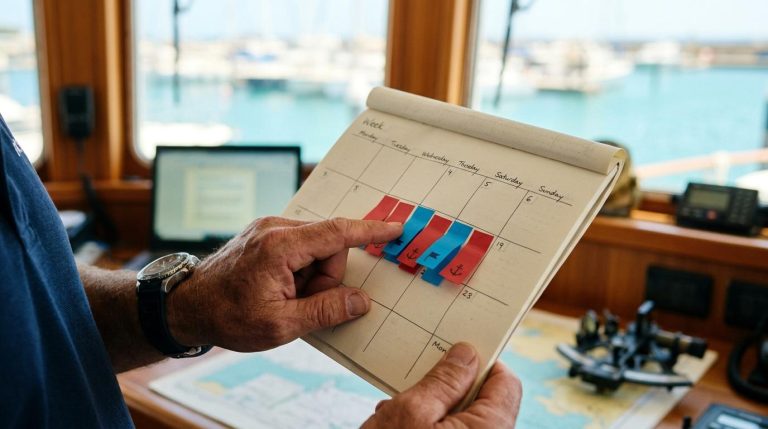
A charter yacht’s earning power is not decided by brochure rates alone. It is shaped by days on the calendar, and by who gets those days.
That sounds obvious, yet it is where many revenue plans go wrong. Owners often begin with an annual charter target, then fit personal cruising around it later. In practice, the order needs to be reversed. A realistic operating calendar starts with owner priorities, technical downtime, crew logistics and regional seasonality, then measures what is truly left to sell.
Revenue starts with availability
Every day reserved for private use is a day that cannot be sold to a charter guest. That one-to-one trade-off sits at the centre of yacht charter revenue planning.
Private owners often use their yachts less than expected across a full year, sometimes only a few weeks in total, while fixed costs continue regardless. That is one reason charter management can make sense: periods of non-use can be converted into income. Still, the calendar has to be honest. A yacht is never commercially available for 52 weeks. Even before owner holidays are added, there are service intervals, charter turnarounds, compliance checks, crew rest periods and, in some cases, repositioning between cruising grounds.
An illustrative example makes the point clearly. If a yacht has 50 genuinely marketable charter weeks in a year, and a prime charter week could bring in around US$25,000, owner use has a visible effect on gross income.
| Owner use per year | Charter weeks left | Gross income forgone at US$25,000/week |
|---|---|---|
| 0 weeks | 50 | US$0 |
| 4 weeks | 46 | US$100,000 |
| 8 weeks | 42 | US$200,000 |
| 12 weeks | 38 | US$300,000 |
| 16 weeks | 34 | US$400,000 |
| 20 weeks | 30 | US$500,000 |
This does not mean owner use is a mistake. It means owner use has a measurable cost, and that cost should be planned, not guessed.
Gross revenue is only part of the picture, of course. Net revenue will depend on commission, operating costs, maintenance and the yacht’s wider management structure. Yet availability remains the first filter. If the weeks are not open, they cannot produce income.
Prime dates are worth more than others
Not all owner weeks carry the same financial weight.
Most owners want the yacht at the same time charter clients want it: July and August in the Mediterranean, festive periods in the Caribbean, school holidays, regatta weeks and major events. Those dates usually deliver the strongest rates and the highest booking confidence. So while one owner week in a quiet shoulder month may have modest revenue impact, one owner week in peak summer can remove one of the most valuable slots in the year.
This is why “how much time do I want onboard?” is only half the question. The other half is “when do I want it?”
A sensible planning process separates the calendar into commercial value bands:
- Peak season: strongest rates, fastest booking pace
- Shoulder season: good cruising conditions, softer pricing
- Event periods: premium demand around regattas and holidays
- Low season: weaker occupancy, useful for maintenance or owner flexibility
That approach gives owners a clearer view of opportunity cost. Eight weeks of use taken across lower-value dates is a very different financial choice from eight weeks split across prime summer and festive holidays.
What a realistic operating calendar must include
The cleanest-looking charter calendar is often the least believable. Real yachts need breathing space.
A workable operating plan has to include more than “owner weeks” and “charter weeks”. It should also protect the yacht’s condition, allow the crew to operate properly and leave enough room for the unexpected. When those blocks are ignored at the planning stage, they reappear later as cancelled bookings, stressed crew, delayed departures or disappointing revenue.
Typical non-charter blocks include:
- Turnaround days
- Crew leave
- Annual servicing
- Yard periods
- Repositioning passages
- Safety checks
- Weather contingency
Even one extra buffer day between charters can reshape the season. On paper, back-to-back bookings look efficient. In reality, compressed turnarounds can put pressure on provisioning, housekeeping, engineering checks and guest readiness. That may be manageable once or twice, but not as a long-term operating habit.
For yachts moving between regions, the calendar becomes even tighter. A vessel finishing a Mediterranean season may need transit time, technical work and rest for the crew before starting a Caribbean programme. Those days are not empty space. They are part of the cost of operating across two markets.
Choosing a structure for owner use
Once the year’s non-negotiable operational blocks are in place, the next step is deciding how owner time will be reserved. This is where many management agreements differ.
Some owners prefer fixed dates locked in early. Others want flexibility and are happy to take time where charter demand is lighter. Neither approach is automatically better. The right fit depends on whether the aim is to maximise income, offset a portion of annual costs, or keep charter activity selective while preserving plenty of personal access.
Common models include:
- Points-based usage: owner time is allocated through an annual allowance, with prime dates costing more points than quieter periods
- Fixed owner blocks: specific weeks are reserved at the start of the season and removed from sale
- Blackout rules: certain premium dates are kept for charter use only
- Last-minute access: owners can take open dates close to departure if the yacht has not been booked
Points systems are useful because they reflect the fact that dates are not equal. A week in late June or at Christmas may “cost” more than a week in early May, which nudges owner use towards periods with lower commercial impact while keeping choice intact.
Fixed blocks are simpler to administer and easy for families who plan far ahead. The drawback is that they can create awkward gaps in the charter calendar. A yacht that has owner use from Wednesday to Sunday, then another owner booking ten days later, may be harder to sell efficiently than one with clean weekly availability.
Blackout periods can feel restrictive, though they often protect the dates that do the heaviest revenue lifting. Last-minute owner access works well when the owner is flexible and close enough to travel on short notice.
Forecasting should shape the calendar, not follow it
A strong operating calendar is built with market behaviour in mind. Historical booking patterns, broker feedback, lead times and regional demand all help show which periods are likely to sell well and which may need pricing support.
In the Mediterranean, core summer weeks are rarely a mystery. What matters more is how shoulder months perform, how early key weeks are booking, and whether events or macro travel trends are changing demand. In the Caribbean, festive charters and winter escapes tend to hold value, but the same principle applies: some weeks have a deeper booking pool than others.
This is where data-led pricing has real value. Public charter management material from Nicholson Yachts, for example, highlights dynamic market analysis, competitive pricing and owner reporting through a secure portal. That sort of approach does not just affect the rate on a listing. It affects the calendar itself. Better pricing can pull demand into shoulder periods, fill soft gaps and reduce the temptation to sacrifice peak availability for revenue that could have been generated elsewhere.
A good forecast also helps settle owner requests early. If a requested week looks weak commercially, granting it for private use may be an easy decision. If the same week is already attracting broker interest, the owner can see the trade-off before the season is committed.
A calendar should match the owner’s real objective
Many owners say they want charter income, but their actual goal is often more specific than that.
Some want to offset crew, dockage and routine running costs. Some want the yacht active while they are away, without pushing occupancy too hard. Some want to keep personal use generous, then charter only enough to reduce the annual carry. A smaller group want the yacht run almost like a commercial asset, with owner use fitted carefully around the most profitable periods.
That distinction matters because the right calendar for one owner may be entirely wrong for another.
If the aim is cost relief rather than maximum yield, it may make sense to reserve more personal time and focus on a smaller number of premium charters. If the aim is stronger annual return, peak season owner use may need tighter limits, with private trips directed towards shoulder months where weather is still attractive and the commercial sacrifice is lower. Kruger Safari Africa’s guide to Greater Kruger seasons underscores how traveller demand and experience shift month by month, reinforcing the case for nudging private trips into shoulder periods to protect peak‑season yield without losing good conditions.
The most useful calendars are built from that starting point, not from a generic target like “twenty charter weeks”.
Practical planning before the season opens
The easiest calendar to manage is the one that is agreed early, priced intelligently and reviewed regularly.
That usually means mapping the year in layers. First come immovable blocks: yard time, surveys, crew leave, repositioning and any owner dates that cannot shift. Then come the high-value charter windows, which should be opened to the market with enough lead time to capture early demand. Only after that should the remaining flex weeks be treated as negotiable.
A few habits tend to make the biggest difference:
- Set owner priorities early: fixed family dates, preferred cruising areas and any event weeks should be declared before the sales push begins
- Protect saleable patterns: clean weekly availability is easier to market than fragmented short gaps
- Review monthly: bookings, enquiries and market pace can justify small adjustments before gaps become dead space
There is also a human side to this. Crew performance, guest satisfaction and yacht condition all improve when the calendar is realistic. A yacht that is constantly squeezed for one more charter or one more owner trip can still look busy, yet perform poorly over time.
The strongest operating calendars do not try to fill every day. They set out, with discipline, which days should earn, which days should be enjoyed privately, and which days must be reserved so the yacht can keep doing both well.