If your first yacht charter in the Mediterranean includes an evening arrival into a busy marina, one scene tends to stand out. Yachts reverse slowly towards the quay, crew members wait with coiled lines, fenders hang high on both sides, and a passerelle appears only when the boat is firmly in place.
That is stern-to mooring, often called Mediterranean mooring or Med mooring. It can look tense from the dock, yet it is a very normal part of life in Mediterranean harbours. For first-time charter guests, a little context goes a long way. Once you know what the crew are doing, the whole manoeuvre makes much more sense.
What stern-to mooring means in a Mediterranean marina
Stern-to mooring means the yacht backs in so the stern sits closest to the quay, while the bow points out towards open water. The stern is secured with lines to the dock, and the bow is held in place either by the yacht’s own anchor or by a pre-laid marina mooring line, often called a lazy line.
This layout is common because many Mediterranean marinas are built around straight quay walls rather than finger pontoons. In older ports, you may see a long concrete waterfront with cleats or bollards and very little space for side-on berthing. Stern-to allows many yachts to fit neatly along the same stretch of quay.
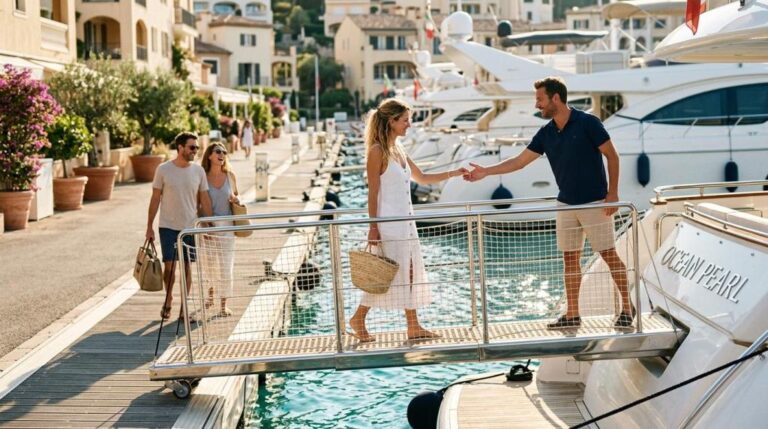
It also shapes the whole arrival experience. Boarding usually happens over the stern, often via a swim platform or passerelle, which is why you will often see charter yachts lined up neatly with their aft decks facing the restaurants, promenades and harbourfront cafés.
| Mooring style | Yacht position | How the yacht is held | Boarding point | Typical use |
|---|---|---|---|---|
| Stern-to | Stern at quay, bow out | Stern lines to quay plus anchor or lazy line forward | Stern platform or passerelle | Very common in Mediterranean marinas |
| Alongside | Side of yacht parallel to dock | Bow, stern and spring lines to pontoon or quay | Side deck | Common where finger pontoons exist |
| Bow-in | Bow at quay, stern out | Bow lines to quay, stern off dock | Bow area | Less common, used in specific layouts or weather conditions |
Why stern-to berthing is so common in Mediterranean harbours
A lot of it comes down to space. In busy coastal towns, marinas and town quays need to fit as many yachts as possible into a limited waterfront area. Stern-to berthing does that efficiently without needing a finger pontoon for every boat.
There is also a practical side for charter guests. Many modern yachts are designed with the stern as the main social and access point. The swim platform, aft deck and passerelle all work naturally with a stern-to berth. Once the yacht is secure, stepping ashore is simple and provisioning is usually easier too.
Local custom matters as well. In many parts of Greece, Croatia, Italy, Turkey, France and Spain, stern-to is simply the expected way to berth. The marina may assign a place and assume the captain will reverse in. In some harbours, dropping your own anchor is allowed. In others, the marina will require use of a lazy line system instead.
How a stern-to manoeuvre happens step by step
The movement itself is quite methodical. The crew are not improvising. Even when conditions are busy, the approach usually follows a familiar pattern.
A typical stern-to arrival looks like this:
- Prepare fenders, stern lines and anchor or lazy line gear.
- Confirm the berth and check wind, current and nearby boats.
- Drop anchor or pick up the marina’s forward mooring line.
- Reverse slowly towards the quay while controlling distance and alignment.
- Pass stern lines ashore and secure them.
- Adjust the bow line or anchor chain so the yacht sits at the right distance off the quay.
Preparing before the yacht enters the berth
Most of the work starts before the yacht reaches the marina wall. Fenders go out early, and they are often set a little higher than guests expect because neighbouring yachts may sit close with different deck heights. Stern lines are made ready at both aft quarters. If the yacht will use its own anchor, the bow team checks that the windlass is ready and the chain can run freely.
The captain also watches for wind and prop walk, especially on a monohull sailing yacht. Reverse gear does not always send a yacht straight astern. Some boats pull one way more than the other, so the helmsman plans for that rather than fighting it at the last second.
Reversing towards the quay
Once lined up, the yacht begins moving astern at low speed. If using its own anchor, the bow team drops it far enough out from the quay to give the boat room to reverse in while paying out chain. The anchor is not just holding the yacht in place. It also helps keep the bow controlled as the stern approaches the dock.
As the yacht enters the gap between neighbouring boats, things can look tighter than they really are. Slow speed is everything here. Short bursts of power, a pause in neutral, and careful steering give the captain far more control than rushing in. If there is a crosswind, the crew may secure the windward stern line first to stop the boat being blown sideways.
When the stern is close enough, stern lines go ashore to cleats or bollards. Only once those lines are made fast does the crew fine-tune the position, tightening or easing the anchor chain or lazy line to keep the yacht close enough for boarding but not touching the quay.
What the captain, crew and dockhands are doing during stern-to mooring
For guests, the most useful thing to know is that stern-to berthing is a team effort. On a fully crewed charter, the captain manages the manoeuvre and the deck team carry out their roles in sequence. Dock staff often help, especially in larger marinas.
You will usually see something like this:
- Helm: keeps the yacht centred, manages gears, throttle and any thrusters.
- Bow crew: handles the anchor or lazy line and watches the lead of the chain.
- Stern crew: prepares lines, judges the distance to the quay and passes lines ashore.
- Dock staff: catch lines, indicate cleats and sometimes hand over the lazy line.
Clear communication matters more than volume. In wind or engine noise, crews often use short, repeated calls or simple hand signals. The aim is not drama. It is calm timing.
On many luxury charters, guests are asked to remain seated or well clear until the yacht is secured. That is not because anything is wrong. It is just the safest way to keep the stern working area free while lines are moving and the boat is still adjusting position.
Common stern-to mooring terms first-time charter guests hear
The language can sound technical at first, especially if several jobs are happening at once. A few words come up again and again during a Mediterranean berth.
You are likely to hear:
- Anchor
- Chain
- Lazy line
- Stern lines
- Passerelle
- Windward
- Leeward
- Thruster
- Prop walk
A lazy line is worth a special mention because many first-time charterers confuse it with an anchor. It is a permanent marina mooring line that runs from the seabed up towards the quay. Instead of dropping the yacht’s anchor, the crew pick up that line and use it to hold the bow forward.
A passerelle is the gangway used for boarding from stern to shore. It does not come out until the yacht is settled and the line tension is right.
The main stern-to mooring challenges in wind and tight spaces
The biggest complication is usually side wind. A gust can push the bow off line while the stern is still moving towards the dock. That is why captains often start the manoeuvre a little upwind of the berth and keep the speed very low. Control matters far more than style.
Neighbouring anchor chains are another issue. In a crowded harbour, boats ahead of you may already have anchors laid out from the bow. If your chain crosses another yacht’s chain, both boats may have trouble later, especially when one leaves before the other. Experienced crews look at the angle of nearby boats and try to keep their own chain running in line with the pattern already on the seabed.
Then there is the basic pressure of reversing a large yacht into a narrow space while people watch from the dock. That part is real, but it should not be exaggerated. Good captains will abandon the first attempt and go round again if the approach is not right. A second try is routine, not a failure.
Stern-to mooring safety points every guest should know
Most risks during stern-to berthing are very manageable, but only if everyone respects the working area. Lines can tighten suddenly, the passerelle must not be used too early, and no one should ever try to fend off a yacht with hands or feet.
The safest habit for guests is simple: listen to the crew and stay clear until invited to move. That gives the team room to work and keeps everyone away from loaded lines and moving gear.
A few safety points are worth keeping in mind:
- Stay clear: do not stand on the swim platform or passerelle during the manoeuvre.
- Keep hands inboard: never place a hand, leg or foot between the yacht and quay.
- Wait for permission: board or step ashore only when the crew say the yacht is secure.
- Watch loose clothing: scarves, bags and straps can catch on cleats, rails and lines.
- Leave line handling to crew: even a small mooring line can come under heavy load very quickly.
If children or older family members are on board, the crew will often suggest the best place to wait during docking. That kind of small planning makes arrivals calmer for everyone.
Why stern-to mooring suits charter life so well
Once the boat is tied up, the benefits become obvious. Guests can step ashore directly from the stern, the aft deck faces the marina, and the yacht feels connected to the harbour rather than hidden from it. In the Mediterranean, that is part of the charm. Dinner might be a short walk away, provisions can come straight aboard, and the evening view is often across the waterfront from your own aft deck.
There is a social side to it too. Mediterranean quays are lively places, and stern-to mooring places the yacht right in the middle of that atmosphere. You can watch the harbour wake up in the morning, see neighbouring boats arrive, and enjoy the familiar ritual of crew lowering the passerelle as the day winds down.
For a first charter, stern-to mooring often starts as the part guests worry about most. Very quickly, it becomes one of the details that makes the trip feel unmistakably Mediterranean.