Booking a luxury yacht charter can feel like organising a private floating villa, a restaurant reservation, a watersports programme and a travel plan all at once. A good charter broker turns that into a clear sequence, keeps the paperwork tidy, and makes sure what you think you’re booking is what turns up at the dock.
Working with a broker also helps you compare options fairly. Online listings can look similar until you get into cabin layouts, crew set-ups, local taxes, and what’s actually included in the price.
Step 1: Start with a clear brief (but don’t worry about being perfect)
Most charters begin with a message or call that’s a mix of firm details and loose ideas. Your broker will expect that, and will ask the questions that tighten it up.
After you’ve shared a first outline, it helps to send a simple set of basics in one place:
- Dates (ideal and flexible)
- Guest count
- Preferred cruising area
- Motor or sailing
- Must-have features
- Budget range
- Occasion (birthday, anniversary, business trip)
That gives a broker enough to check availability quickly, then come back with realistic options rather than a long list of yachts that look nice but will never work for your week.
Step 2: Broker consultation (where the charter starts to take shape)
The consultation is where “we want the Med in summer” turns into something bookable. Expect your broker to talk through weather patterns, busy weeks, travel days, and the practical side of moving a yacht between islands or ports.
A broker might also flag considerations that don’t show up in glossy photos: tender arrangements, how stabilisers perform at anchor, whether the master cabin is full-beam or squeezed forward, and how the yacht feels when all guests are on board at once.
If you’re planning with Nicholson Yachts, or any established charter brokerage, this stage is also where industry knowledge matters most: brokers tend to know which yachts are consistently well run, which crews are brilliant with families, and which boats suit guests who care more about quiet anchorages than nightlife.
Step 3: Shortlist yachts that truly fit (not just “sleep 10”)
Once your broker has your brief, they’ll send a curated set of yachts with brochures, spec sheets, and pricing. Don’t be surprised if the best match is not the largest yacht you can afford. Layout, crew style, and itinerary can matter more than extra metres.
One of the most useful parts of working with a broker is interpretation. Two yachts may both “sleep 10”, yet one has five equal doubles and the other has bunks better suited to children. That changes the whole feel of the trip.
A few checks that help you compare like-for-like:
- Cabin configuration: Who gets what, and are there any bunks or Pullmans?
- Crew dynamic: Formal service, relaxed family style, or something in between?
- Watersports kit: What’s on board, what needs licensing, what costs extra?
- Noise and privacy: Crew flow, thin bulkheads, and how guest areas are arranged
- Range and cruising speed: Matters if you want longer passages between stops
Step 4: Confirm availability and place a “hold”
When you pick a favourite, your broker will confirm the yacht is genuinely available for your dates and cruising area. In busy seasons, the next step is often a short hold period while paperwork is prepared. A hold gives you breathing room to review terms without someone else taking the week.
This is also where a broker can advise whether it’s worth holding a second-choice yacht as a back-up, especially when flights are booked and your dates cannot move.
Step 5: Contracts, terms, and what you are agreeing to
Most luxury charters use well known industry contracts (often MYBA for many motor yacht charters). Your broker will walk you through the agreement, translate the legal language into plain English, and confirm practical details like embarkation and disembarkation times.
This stage is not only about signing. It’s where small details prevent big misunderstandings: what happens if weather changes the itinerary, what counts as “reasonable wear”, and what cancellation terms apply.
You’ll usually see a deposit requested to confirm the booking (often a significant percentage of the charter fee). Your broker will tell you the amount, the deadline, and the payment method, and will confirm when the booking is locked in.
Step 6: Make sense of the money (charter fee vs running costs)
Luxury yacht pricing has layers. The headline weekly rate is only one part of what you’ll spend, and it’s normal to have separate line items for costs incurred during the week.
Here is a simple way to look at the typical structure:
| Cost item | What it is | When it’s paid | Notes |
|---|---|---|---|
| Charter fee | The base hire of the yacht and crew | Deposit + balance before charter | Covers crew wages and standard onboard operating costs |
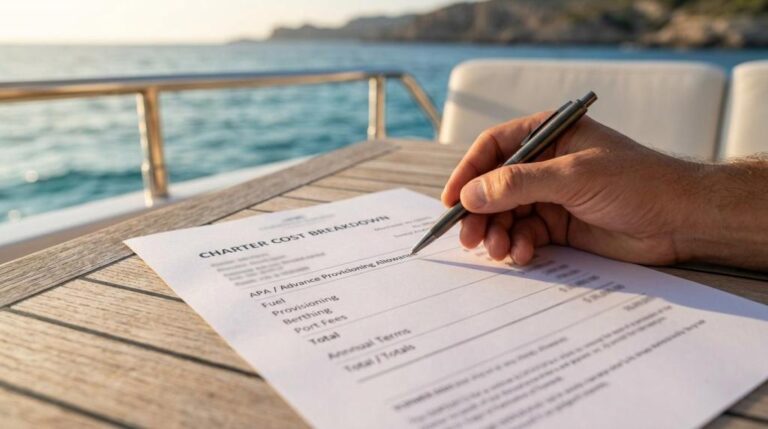
| APA (Advance Provisioning Allowance) | A fund to pay trip expenses | Before charter | Used for food, drink, fuel, berthing, port fees, some requests |
| VAT / local tax | Tax charged in some cruising areas | With charter payments | Rate depends on location and yacht status |
| Delivery / repositioning | Moving the yacht to your start point | Before charter | Only applies when relevant; broker confirms early |
| Gratuity | Tip for the crew | End of charter | Often given as a range; it’s discretionary |
APA is often the piece that first-time charterers find confusing. It’s not a hidden fee; it’s a practical method used so the captain can pay day-to-day costs on your behalf while keeping everything documented. You’ll receive an APA account summary at the end of the charter, with any unused funds returned (or occasionally an extra top-up requested if the itinerary and usage outpace the initial estimate).
Step 7: The preference sheet (where it becomes “your” yacht)
After the contract is signed, you’ll complete a preference sheet. This is shared with the captain and key crew, usually via your broker, so the yacht can provision correctly and tailor the week.
It’s worth taking this seriously. A thoughtful preference sheet is the difference between a good charter and one that feels effortless.
- Dietary needs: Allergies, intolerances, medical requirements
- Food style: Simple Mediterranean lunches, tasting menus, plant-forward, children’s favourites
- Drinks: Spirits, wine preferences, zero-alcohol options, brands you love
- Daily rhythm: Early breakfasts, late nights, lots of shore time, lots of watersports
- Celebrations: Cakes, flowers, music, surprise moments
If you’re travelling with children, mention nap times, snack habits, and confidence in the water. If you’re travelling with mixed groups, note privacy needs and who prefers quieter anchorages.
Step 8: Itinerary planning with reality built in
Many guests arrive with a list of places they’ve saved on a map. Your broker and the captain help turn that into an itinerary that fits distances, marina availability, and the way you actually want to spend your days.
A practical itinerary leaves space for weather and mood. It also considers when you want to be “seen” versus when you want to disappear into a calm bay with paddleboards and lunch on the aft deck.
Your broker’s role here is part creative, part logistical: coordinating requested reservations or experiences, and keeping the plan workable inside the cruising area and the charter week.
Step 9: The final run-in (documents, boarding, and timing)
In the last week or two before departure, the admin ramps up. You’ll normally confirm passenger details for the ship’s manifest, provide passport information where required, and finalise arrival times at the marina.
Your broker will also make sure you know what to expect on embarkation day: when you can board, what happens with luggage, and how the captain will brief you on safety and the week ahead.
If flights are delayed or weather changes the plan, your broker can liaise with the captain or yacht manager, helping keep the experience calm at the point when you most want it to be.
Step 10: Support during the charter (quietly in the background)
Many charters run perfectly without you needing to speak to your broker once you’re on board. Still, it’s reassuring to know they are there if something needs attention: a change request, a misunderstanding, or an operational issue that requires an owner-side decision.
Brokers also help after the charter with any final questions about APA reconciliation and, if you want, planning the next trip with notes on what worked and what you’d change.
Booking timeline: how early should you start?
Timing depends on the destination and the type of yacht. Prime weeks in the Mediterranean summer and Caribbean winter can book far ahead, especially for popular family-friendly yachts with top crews.
If your dates are fixed and the yacht type is specific, speak to a broker early. If you’re flexible, last-minute options can appear, though the choice set is narrower and itinerary planning may be more constrained by where the yacht already is.
Using a broker’s tools without getting lost in listings
Websites and search tools are useful for shaping your taste: size, style, destinations, and indicative weekly rates. Brokers at firms like Nicholson Yachts often combine that browsing with first-hand insight into which listings are genuinely strong for your trip.
A sensible approach is to use online search to narrow your “type”, then let your broker pressure-test it. If you love the idea of a sailing yacht but want long hops between ports, say so. If you want a quiet week but keep sending party yacht videos, say that too. Clarity saves time and sharpens the shortlist.
Quick checklist before you pay a deposit
Before funds are sent, make sure you can answer these in plain language. Your broker should be able to confirm each one without hesitation.
- What is included: Crew, standard equipment, and the obvious day-to-day basics
- What is extra: APA items, taxes, delivery fees, premium watersports, shore experiences
- Where you start and finish: Ports, times, and any constraints on cruising
- Cancellation terms: Deadlines, penalties, and what travel insurance may cover
- Payment schedule: Deposit amount, balance date, APA payment timing
The aim is not to be cautious to the point of losing the fun. It’s to make sure the exciting parts of the trip stay exciting, because the fundamentals are clear and agreed.
If you already have a destination and month in mind, a broker can usually turn that into a workable shortlist quickly, then refine it until it feels like your week, on your yacht, with the right crew and the right pace.