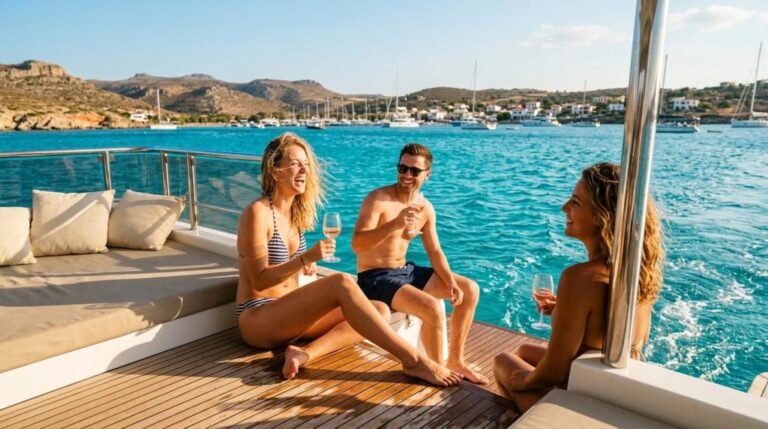
Few features change the feel of a yacht as quickly as effective stabilisation. Guests may not ask about roll angles or control systems, yet they notice straight away whether lunch on deck feels calm or whether a night at anchor turns into a restless one.
That is why the choice between gyro stabilisers and fin stabilisers matters so much in charter. Both aim to reduce roll. Both can make a yacht more appealing. Still, they do not deliver comfort in quite the same way, and they do not suit every yacht or itinerary equally well.
How gyro stabilisers and fin stabilisers work on yachts
A gyro stabiliser is installed inside the yacht. It uses a fast-spinning flywheel to create force that resists roll. Because the machinery sits within the hull, there are no external appendages extending into the water. This is one reason gyros are often linked with sportier motor yachts and designs where drag is a concern.
A fin stabiliser works very differently. Fins project from the hull below the waterline and move to generate hydrodynamic lift, countering the yacht’s rolling motion. Traditional fin systems were strongest while the yacht was underway, though modern zero-speed fins are designed to work at anchor as well.
The result is that both systems can improve comfort, but the feel and the best-use case tend to differ.
| Feature | Gyro stabilisers | Fin stabilisers |
|---|---|---|
| Main location | Inside the hull | External fins below the waterline |
| Best-known strength | Comfort at anchor and low speed | Comfort underway, especially on larger yachts |
| Drag impact | No appendage drag | Some drag, though modern designs reduce it |
| Warm-up | Needs spin-up time | Available as soon as the system is active |
| Typical fit | Smaller to mid-size yachts, fast motor yachts | Larger motor yachts and superyachts |
Comfort differences between gyro stabilisers and fin stabilisers
From a guest point of view, the biggest question is simple: when does the yacht feel calmer?
Gyros have built a strong reputation for at-anchor comfort. That matters in charter because plenty of valuable guest time happens while stationary: breakfast in a bay, afternoon swimming, cocktails before dinner, or sleeping overnight in a gentle swell. In these moments, a gyro can make the yacht feel far more settled.
Fins have long been the benchmark for reducing roll while cruising. On passage, especially in mixed sea conditions, they can keep a larger yacht feeling more level and composed. On modern yachts with advanced control systems, zero-speed fins have also narrowed the gap when the yacht is not moving.
So the comfort difference is not really about one system being universally better. It is more about where the yacht spends its time and what guests are doing when motion becomes most noticeable.
After that broad comparison, the typical comfort pattern usually looks like this:
- At-anchor lounging
- Sleeping in an anchorage
- Dining while stationary
- Longer cruising legs
- Open-water passages
- Fast transfers between ports
At-anchor performance and zero-speed comfort for charter yachts
If the charter plan revolves around coves, beach clubs, swimming stops and overnight anchorages, gyros deserve serious attention. They do not depend on water flow over a foil to create stabilising force, so they remain highly relevant when the yacht is still or drifting slowly.
This is also where guest perception becomes very practical. A yacht that looks beautiful in the brochure may feel uncomfortable if it rolls noticeably while guests are trying to eat, sunbathe or sleep. In those moments, the value of a calmer platform becomes obvious very quickly.
That said, it would be too simplistic to say fins are weak at anchor. Modern zero-speed fin systems have improved a lot. On many larger yachts, they deliver very strong at-rest performance and remain a popular solution. The gap is smaller today than it was with older underway-only fin systems.
There is one operational detail worth keeping in mind. A gyro needs time to spin up before it can deliver full effect. Fins do not have that same warm-up cycle. For charter crews, that affects planning. If guests are leaving the dock and expect comfort straight away, a gyro should already be running.
Underway comfort, drag and yacht speed profiles
Once a yacht is cruising, especially in beam seas or on longer runs, fin stabilisers often show their strength. As speed rises, water flow across the fins increases, and that gives the system more authority. This is one reason fins remain common on larger yachts that spend meaningful time underway.
For displacement yachts and larger charter vessels, that matters a great deal. Guests may move around the interior, use the saloon during a passage, or sit for meals while the yacht covers distance between anchorages. A strong underway stabilisation system can change the whole character of the trip.
Gyros can still improve comfort while cruising, but they are often most attractive on yachts where avoiding appendage drag matters. Fast motor yachts, sporty designs and some modern performance-led charter yachts fit that description well. Without external fins, the hull stays cleaner in profile and avoids some of the trade-offs linked with underwater appendages.
A sensible shorthand is this: fins tend to shine more as cruising demands increase, while gyros often stand out where the yacht alternates between speed and relaxed time at anchor.
Maintenance differences between gyro stabilisers and fin stabilisers
Maintenance is where the choice becomes less glamorous and more operational. Charter reliability depends not just on comfort, but also on how often a system needs service, what type of specialist support it requires, and how exposed its components are to saltwater and wear.
A gyro keeps its main working machinery inside the yacht, which removes underwater fin seals, shafts and appendage-related servicing from the picture. That can simplify some parts of ownership. Even so, a gyro is not maintenance-free. Cooling systems, corrosion control, mounts, brake-related components and electrical connections still need routine attention.
Fin systems usually bring a broader marine-mechanical service footprint. Hull units, actuators, seals, shafts, hydraulics and control components all need inspection and periodic maintenance. Because part of the system operates at the hull interface or outside it, environmental exposure is simply higher.
In practical terms, the maintenance split often looks like this:
- Gyro service focus: cooling circuits, mounts, electrical connections, brake or hydraulic support systems
- Fin service focus: hull units, actuators, shafts, seals, hoses, valves and control systems
- Gyro exposure profile: core machinery is more protected inside the yacht
- Fin exposure profile: more components face seawater, marine growth and hull-related wear
The other point often missed in sales conversations is service access. A system may be excellent on paper, but charter use depends on having technicians, spare parts and yard familiarity in the regions where the yacht actually operates.
What charter listings suggest about stabiliser preferences
Public charter listings rarely give a full engineering brief, but they do show what brokers and managers think guests care about.
One Nicholson Yachts listing for the 23-metre SEA STORY specifically highlights Seakeeper gyroscopic stabilisers and markets them as a comfort feature for both smooth cruising and time at anchor with barely any movement. That is useful because it shows how a gyro is positioned in a guest-facing charter context, not just in technical language.
Across larger charter yachts, listings often mention “stabilisers” without naming the exact technology. That makes sense. The guest benefit matters more than the mechanical detail in most charter marketing. It also means there is no clear published Nicholson policy stating that gyros are right for one size range and fins for another.
Still, a cautious pattern can be read from the wider market. Gyros are often highlighted on modern, performance-oriented yachts where at-anchor comfort and clean hull lines are attractive selling points. Fins remain deeply established on larger yachts, especially where long cruising legs and larger displacement platforms are part of the brief.
When gyro stabilisers make sense for charter use
Gyros make a lot of sense when guest time is centred around anchoring rather than passagemaking. Think of charters built around short hops, beach stops, watersports and quiet nights in sheltered bays. In that setting, a calmer yacht at rest can mean happier guests and fewer complaints about motion.
They are also a strong match for yachts where external fins are less desirable. Fast motor yachts, sleek sport yachts and some chase-boat style platforms often benefit from an internal system that avoids underwater appendages.
Typical charter situations where gyros are especially appealing include:
- short Mediterranean island hops
- day charters with long swimming stops
- sporty yachts where drag matters
- guests who are sensitive to roll at anchor
- shallow or debris-prone cruising areas
When fin stabilisers make sense for larger yachts and longer passages
Fin stabilisers come into their own when a yacht is expected to cruise properly, not just move between nearby anchorages. Larger charter yachts often spend longer periods underway, and guest comfort during those passages is a major part of the onboard experience.
They are also a mature choice for larger vessels with established engineering spaces, service routines and crews used to managing hydraulic or actuator-based systems. On these yachts, fins are not just common. They are part of the standard expectation of how a serious cruising platform should behave.
The case for fins is often strongest when the charter profile looks like this:
- Yacht size: larger motor yachts and superyachts
- Cruising style: longer legs between ports or anchorages
- Comfort priority: strong roll reduction while underway
- Operational profile: crews and yards already familiar with fin systems
Charter planning factors that matter more than the brochure
The best choice often becomes clear when looking at the actual charter programme rather than the product category.
A yacht spending most of its season in the Med, hopping from bay to bay and lying at anchor through lunch and overnight, may benefit hugely from a gyro-led comfort profile. A yacht running longer coastal passages, carrying more guests and operating on a larger platform may suit fins better, especially if underway composure is the top priority.
Crew routine matters too. Gyros need spin-up planning. Fins bring more external mechanical exposure. Service support matters in both cases, but in different ways. Space and installation constraints matter as well, especially on refits where machinery-room layout can drive the decision as much as performance.
Before choosing between the two, it helps to ask a few plain questions:
- Where does the yacht spend most of its time? At anchor, drifting, or cruising for hours at a stretch.
- What do guests complain about most? Rolling at night, motion during meals, or discomfort on passage.
- What kind of yacht is it? Fast and sporty, or larger and passage-focused.
- How easy is service support? Local technician access can shape long-term reliability as much as the hardware itself.
That is usually where the real answer sits: not in a simple gyro-versus-fin debate, but in matching the stabiliser to the yacht, the itinerary and the guest experience the charter programme is trying to deliver.