Luxury on the water is being judged by a wider set of standards than it was a decade ago. Beautiful styling, long range and refined interiors still matter, but owners and charter guests are also asking tougher questions about fuel burn, marina emissions, material choice and the long-term impact of a yacht’s design.
That shift is no longer theoretical. Hybrid propulsion, shore power and lower-impact construction materials are moving from niche talking points into mainstream yacht conversations, especially in new builds and carefully planned refits. The most interesting part is not that these ideas exist, but that they now work together in practical, measurable ways.
Why the change feels more real now
A sustainable yacht is rarely defined by one feature alone. It is usually the result of many linked decisions: a hull that needs less power to move, an energy system that can switch between diesel and batteries, solar support where deck space allows it, and marina connections that let generators stay off in port.
That broader view matters because yachting emissions do not come only from passage making. A large amount of fuel can be used while a yacht is still, with air conditioning, galley equipment, lighting and charging loads running for hours at anchor or alongside. When designers and owners address both propulsion and hotel loads, the gains become more meaningful.
It also helps that technology has matured.
Battery systems are more capable, control software is smarter, and better shore power infrastructure is appearing in many leading marinas across the Mediterranean, Europe, the United States and parts of the Caribbean and Asia Pacific. For yachts operating in these areas, lower-emission living on board is becoming easier to achieve without giving up comfort.
Hybrid propulsion changes the onboard experience
Hybrid propulsion tends to get attention for environmental reasons, yet many owners first notice the change in a different way: less noise, less vibration and a calmer feel under way. Electric running at low speed can make coastal passages, early departures and time at anchor feel very different from conventional diesel-only operation.
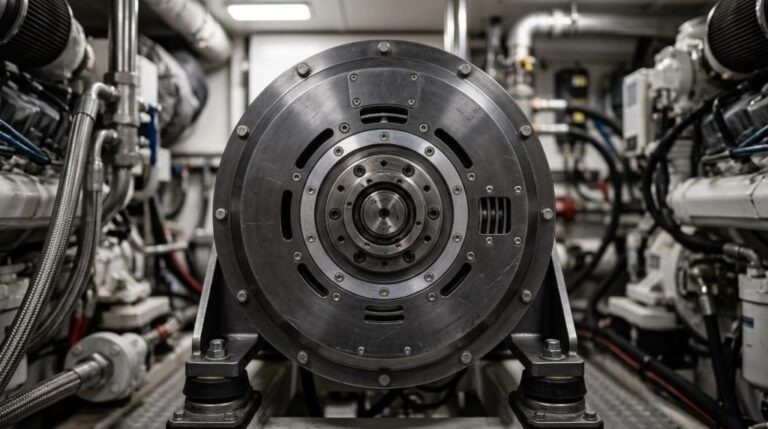
There is no single hybrid format. Some yachts use diesel engines to generate electricity that either drives the shaft or charges battery banks. Others combine electric motors, lithium batteries, solar input and a smaller genset for backup. The right set-up depends on the yacht’s size, intended speed, range expectations and the balance between expedition use and marina-based cruising.
Nicholson Yachts has featured several useful examples of this shift. The XPM 78 Vanguard uses a Praxis diesel-electric hybrid system built around efficient low-speed cruising and flexible power management. Reported figures point to a cruise of around 9 knots at roughly 3.5 litres per nautical mile, giving a range of more than 7,000 nautical miles. That sort of economy changes what long-distance cruising can look like.
At a smaller scale, the Naval Yachts GreeNaval 47 pairs Torqeedo Deep Blue hybrid inboards with BMW lithium batteries. Reported performance includes a cruising speed of about 7 knots, bursts to around 11 knots, range beyond 2,000 nautical miles at slow speed, and limited pure solar-electric running in the right conditions. The formula is different, but the aim is similar: lower fuel use, quieter operation and more flexibility in how energy is managed.
A quick view of the main propulsion paths
Different systems suit different cruising patterns. A yacht built for transoceanic range will not make the same compromises as a solar-focused catamaran intended for warm-weather cruising and long periods at anchor.
| Propulsion approach | Typical set-up | Best suited to | Main strengths | Main trade-off |
|---|---|---|---|---|
| Diesel-electric hybrid | Diesel engines or gensets, electric drive, battery storage | Long-range expedition and displacement cruising | Excellent low-speed efficiency, quiet running, flexible power flow | Higher capital cost and greater system complexity |
| Parallel hybrid | Diesel propulsion combined with electric motors and batteries | Owners wanting mixed-mode use and familiar performance | Can switch between efficiency and power, useful redundancy | Weight, integration demands, specialist service needs |
| Battery-electric with solar support | Electric motors, lithium banks, solar array, backup charging source | Coastal cruising, anchor-heavy itineraries, low-noise use | Near-silent operation, zero local emissions in electric mode | Limited pure electric endurance at higher speeds |
| Solar-electric catamaran | Large solar area, battery bank, electric motors, backup generator on some models | Sunny cruising grounds and low-speed lifestyle use | Minimal daily fuel use in favourable conditions, very low vibration | Dependent on weather, speed expectations need to be realistic |
The common thread is that top speed is often no longer the priority. Efficient cruising, resilience and better onboard comfort tend to come first.
Shore power turns marinas into part of the answer
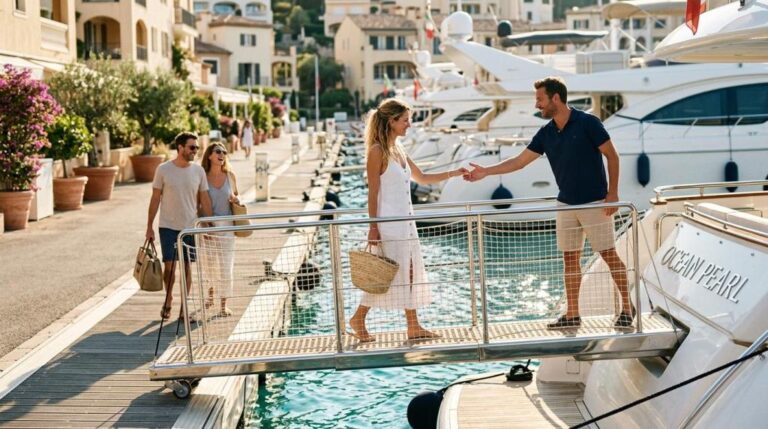
A yacht can be highly advanced at sea and still burn unnecessary fuel in port if it relies on generators for every onboard load. Shore power solves that in a very direct way. Connect to the dock, run hotel systems from the marina grid, charge batteries, and keep the generators off.
That sounds simple, yet it has a surprisingly large effect. Local emissions at berth drop to zero, noise falls sharply, and neighbouring yachts, crew and marina staff all benefit. Generator hours are reduced as well, which can support longer service intervals and less wear over time.
For hybrid yachts, shore power is especially valuable because it allows battery banks to be topped up without using diesel. In practical terms, that means a yacht can leave the marina with charged batteries, run quietly during parts of the next leg, and return without having burnt fuel simply to support life on board while stationary.
After a paragraph like that, the benefits become easy to summarise:
- Quiet berthing
- No generator exhaust in the marina
- Lower fuel use while alongside
- Reduced genset hours
- Better guest comfort at night
Compatibility still matters. Yachts moving between 50 Hz and 60 Hz regions often need converters, transformers and careful switchboard integration. High-capacity connections are also more useful than basic shore leads, especially on larger yachts with demanding HVAC loads. Premium marinas are improving quickly, but owners still need to check what a berth can actually deliver rather than assuming every port is fully equipped.
Sustainable materials start long before launch day
Operational efficiency is only part of the picture. A yacht’s environmental footprint also begins in the yard, with the choice of hull material, decking, insulation, interior finishes, coatings and how easily major components can be repaired or recycled later.
Aluminium is central to many lower-impact yacht concepts. It is light for its strength, corrosion resistant when properly managed, and fully recyclable at the end of a vessel’s life. Nicholson-associated designs such as the GreeNaval 47 and several Kingship concepts show how all-aluminium construction can support efficiency as well as durability. A lighter hull generally needs less power for the same speed, which feeds directly into lower fuel use.
The trade-off is that aluminium production is energy intensive. Even so, a long service life and strong recyclability profile can make it a sensible material when judged across decades rather than only at the build stage. That long view is becoming more common in serious yacht projects.
Composites are changing too. Builders are testing recycled fibres, natural fibres including flax and bamboo, and bio-based resin systems that reduce dependence on petroleum-derived inputs. Low-VOC coatings can also improve conditions in the yard and reduce emissions during the build process.
Interiors are part of this conversation as well. Certified timber, reclaimed wood, plant-based fabrics and lower-impact synthetic alternatives are all appearing more often. Traditional teak decking, once treated almost as standard, now faces competition from recyclable synthetic teak products that avoid tropical hardwood sourcing and lower the maintenance burden.
A sensible materials brief often includes more than the visible finishes:
- Hull structure: aluminium or lower-impact composite strategies where appropriate
- Decking: certified timber or recyclable synthetic alternatives
- Resins and coatings: bio-based and low-VOC options
- Interiors: FSC-certified, reclaimed or recycled content
- Systems: LED lighting, efficient glazing and better insulation
None of those choices makes a yacht sustainable on its own. Together, they can change both operational demand and lifetime impact.
The numbers matter, but so do the trade-offs
It is easy to talk about cleaner yachting in broad terms. Owners usually want clearer answers than that. How much fuel is actually saved? What does the yacht give up? What will the crew need to manage differently?
Published figures from hybrid yachts suggest the gains can be substantial. In one well-known hybrid superyacht case outside the Nicholson portfolio, a 50-metre yacht achieved the same 3,500 nautical mile range as a conventional counterpart while burning about 25 per cent less fuel. Nicholson-listed examples point in a similar direction, with Vanguard reporting very strong economy for long-range expedition cruising and the GreeNaval 47 showing what can be done in a smaller hybrid platform.
Still, greener systems are not magic. Batteries add cost and weight. Battery replacement will become part of long-term ownership planning. Power electronics, cooling systems and energy management software introduce extra layers of complexity, and crews need the training to operate them well.
That said, the picture is not all one way. When diesel engines run fewer hours, they may need less frequent servicing. Electric running can reduce wear linked to prolonged low-load generator use. Shore power can keep machinery off in port for extended periods. Resale value may also benefit when a yacht has been specified with modern, efficient systems that buyers increasingly expect to see.
What owners should ask before buying, building or refitting
The smart approach is to treat sustainability as a technical brief, not a marketing phrase. Much depends on how the yacht will actually be used. A Med season based around short hops and marina stays may favour very different decisions from a yacht crossing oceans on expedition itineraries.
A few questions help bring the subject back to reality:
- Cruising profile: Is the yacht mostly moving at low displacement speeds, or is higher-speed performance still essential?
- Shore power access: Will the yacht spend time in marinas with reliable, high-capacity electrical supply?
- Battery strategy: What is the expected service life, cooling arrangement and replacement cost?
- Material plan: Are the sustainable claims tied to recognised standards or just broad sales language?
- Crew readiness: Is there training in place for hybrid systems, charging routines and energy management?
Those questions often reveal whether a project has been thought through properly. The strongest yachts in this space do not rely on one headline feature. They combine a realistic propulsion package, sensible marina integration and materials chosen with the full service life in mind. When that happens, lower-impact yachting stops sounding like a future promise and starts looking like a better way to own, charter and operate a yacht today.